
With the launch of the government’s Education Estates Strategy, many school leaders will be taking on major building projects for the first time. With tight budgets and high expectations, careful planning, clear priorities and strong teamwork will be key to creating schools that work well now and in the future, writes Glen Moorley, director at TPM Studio
With the government’s Education Estates Strategy now in motion, many school leaders will find themselves leading a significant building project, perhaps even for the first time. With £38 million of investment confirmed for 2025/26 to 2029/30, the opportunity is significant – but so are the pressures. Budgets will remain tight, expectations will be high, and the decisions made early on will help shape the outcome for years to follow.
Having been involved in leading the design and delivery of many school projects with incredibly tight budgets, we’ve seen first-hand how important the mind-set of the school leader truly is – the attitudes, beliefs and assumptions that shape how each project is led and navigated, all while taking the many stakeholders on the journey. Here we set out what we’ve learned about the process and what to draw on to get the very best out of your project.
Start with mindset
The first step is to view every project through a lens of radical practicality, bringing together a bold vision with realistic pragmatism. Visionary, but still achievable. Equally important is to put ego to one side and remain open to ideas, innovation, and alternative approaches.
In fact, the most critical role a school leader can play, especially during the planning and design stage, is that of interrogator. Don’t be afraid to question everything, and more than once.
Know what you need, but be flexible
Before you embark on a project, have a clear wishlist but accept that compromise will likely be required. Think of every space in your upgraded or new building as multi-functional – if it only fulfils one function, it’s a missed opportunity.
At feasibility stage, you’ll be considering upgrades, whether extensions are needed or indeed a new building. Another key decision will be where to accommodate new development on or off your current site.
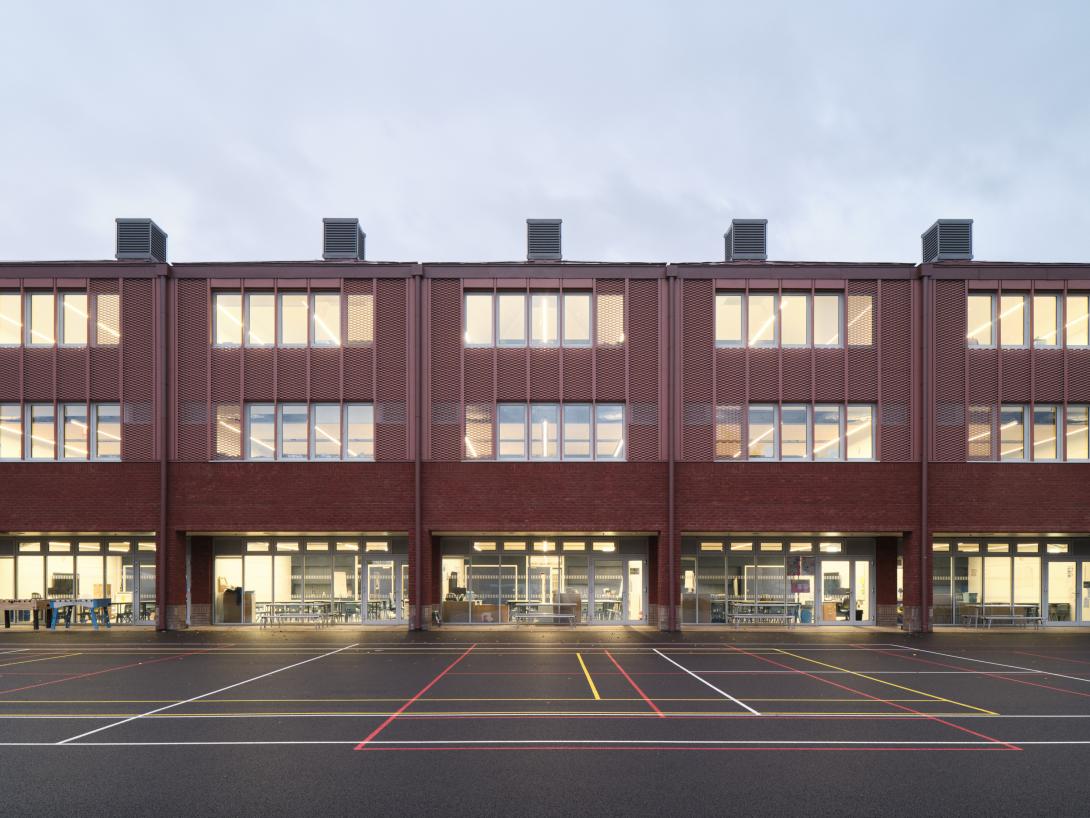
Let’s take Burlington Junior School in New Malden as an example. It needed to expand to accommodate circa 20 per cent more students on its school campus while staying operational. The existing building was at the end of its life, an alternative site was not feasible, and the site had a number of constraints. Working with the school, we first explored where the existing pupils could learn during development and established that there was scope for the new building to be positioned so that existing classrooms could remain in use, removing the need for costly temporary classrooms and minimising disruption to the school.
Having optimised the budget before the project even started, it was then time to explore design ideas and options. As a school leader, you need to be clear from the start what you need most in line with regulations and lean on the project team to show how best that can be accommodated. It’s also a good idea to manage expectations early on, helping everyone to understand the priorities being set and their hierarchy as part of the overall vision.
Review every design detail with budget in mind – everything has a cost. Ask what function every component is serving. Could it do more or do it better? Is it being used enough of the time? Does the cost justify the functionality and expected usage? Is it worth the investment? Consider how you can also offer community benefit, a common requirement now, as well as other “out-of-hours” uses. Security and safety are non-negotiables so these will need to be planned carefully.
Entrances and shared spaces deserve thought and attention, especially areas that are only used at specific times of the day – such as halls, corridors or group spaces. These can be designed in a way so they can serve multiple functions, create connections between year groups and provide flexible space for wider use.
Environmental performance should be considered carefully too. Passive design measures, such as maximising natural daylight, managing solar gain and having good acoustics can all be achieved through design, whist utilising natural and assisted ventilation solutions will offer a significant cost reductions to operations in the long term. We recently worked with one school that was embarking on a school project following last year’s hot summer. Complaints had pushed air conditioning up the priority list but, after further interrogation, it was established that the cost of maintenance and the requirement for cooling over a relatively short period of the school year was not the best use of the budget and focused on more valuable requirements instead.
Inclusion and belonging should be central to the brief, not an afterthought. This means designing spaces that accommodate different needs and where students feel comfortable and safe – a key requirement of the new Education Estates Strategy. It also means providing staff with dedicated space to meet, relax and prepare, creating a place that evokes civic pride throughout the local community.
Model and test solutions
All proposals need to be developed through a rigorous period of review and analysis. There are many moving parts and, having worked through needs, priorities and options, these must be tested, retested and refined. Modelling scenarios helps educational establishments explore different design options, ensure viability and avoid extensive value engineering later.
This process allows design teams to ‘show their workings’, by demonstrating options which have been ruled out, explaining decisions that have been made, and provide understanding to any compromises that had to be made.
Collaborate with the project team
The role of the project team is to deliver an exemplary outcome, providing the school with a facility that is fit-for-purpose, compliant, inspires everyone who uses it and supports high educational attainment. It’s so much more than architectural preference or aesthetics, but with smart planning and taking the time upfront, it can be both beautiful and fit-for-purpose.
Relationships and collaboration are critical. Lean on the architect because they are often the constant throughout the entire project process – other project team members will come and go or just be involved in certain stages. Expect your architect to deliver maximum benefit within your budget and assess everything from the accommodation to the finer details. Afford them the creative drive to push it through – they are experts at navigating complex issues, they listen to all stakeholders and can help manage their expectations. Projects take time, need impetus and direction so seek their support, and try to stay positive.
Finally
For many leaders of schools and colleges, a building project happens just once in their lifetime. To make the most of the opportunity, treat design as a form of ultra modernism, where everything must be functional with little or no space/budget for surface adornment or superfluous decoration. Start from a place where you expect the architecture to facilitate function, balance competing considerations, identify the right priorities, deliver high quality spaces and serve the needs of the students, staff, stakeholders, and the wider community.
Image shows Burlington Junior School. Credit Henry Woide.